
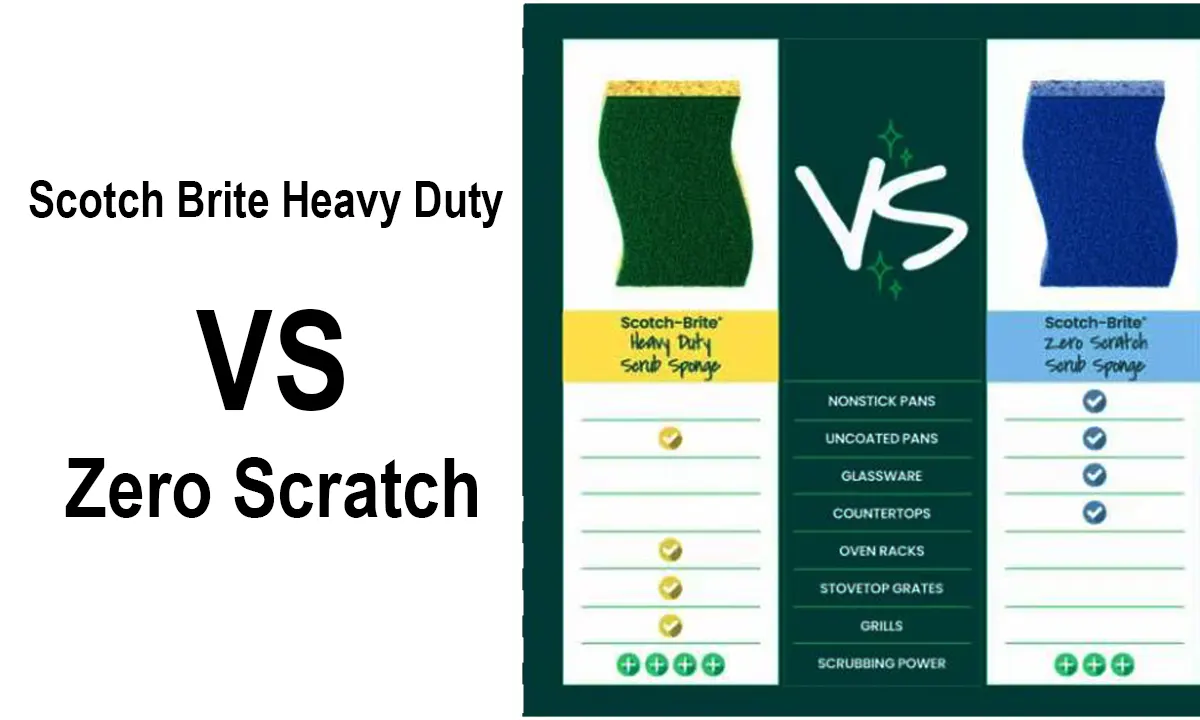
For daily use – Zero Scratch is best [See Current Price on Amazon]
And for heavy duty work – Scotch Brite Heavy Duty is best [See Current Price on Amazon]
If you’ve ever stood in the cleaning aisle staring at the sea of yellow-and-green vs. yellow-and-blue sponges, you aren’t alone. It’s easy to think a sponge is just a sponge, but choosing the wrong one can mean the difference between a clean pan and a ruined, scratched-up piece of premium cookware.
As someone who spends hours testing kitchen gear and cooking for a family, I’ve put both the Scotch-Brite Heavy Duty Scrub Sponge and the Scotch-Brite Zero Scratch Scrub Sponge through the ultimate kitchen gauntlet. Here is how they actually stack up when the grease meets the fiber.
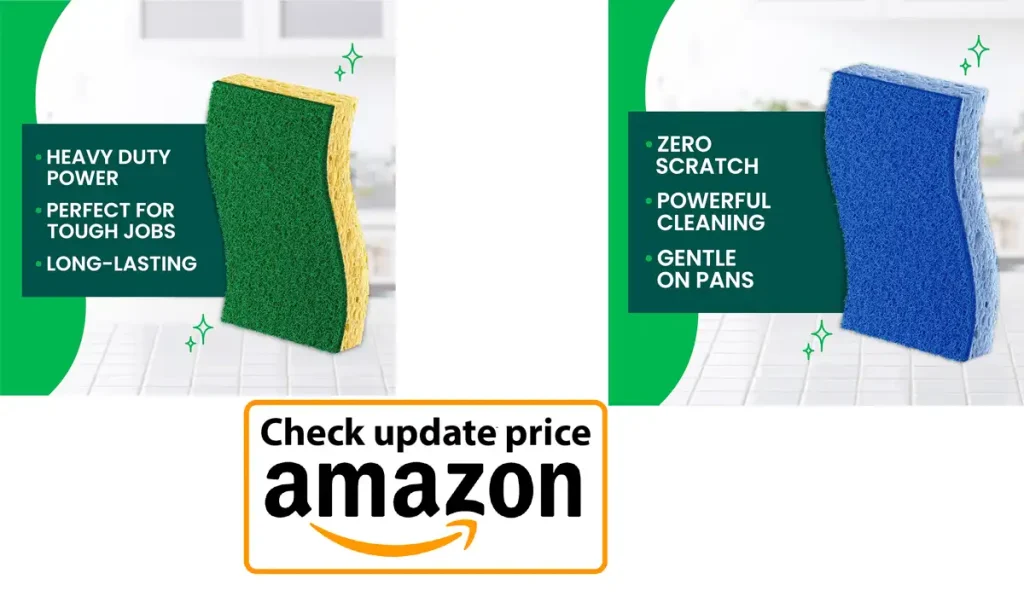
Quick Verdict:
If you are short on time, here is the golden rule of kitchen sponges:
- Buy the Scotch-Brite Heavy Duty (Green) if you frequently cook with cast iron, stainless steel, or have oven grates and concrete-hard baked-on messes that require raw scrubbing power.
- Buy the Scotch-Brite Zero Scratch (Blue) if your kitchen is filled with non-stick Teflon pans, delicate glassware, ceramic cookware, and quartz countertops that scratch easily.
The smart move? Keep a pack of both under your sink.
What is the difference between scotch brite heavy duty vs zero scratch
| Feature | Scotch-Brite Heavy Duty (Green) | Scotch-Brite Zero Scratch (Blue) |
| Abrasive Material | Heavy-duty mineral coated fibers | Delicate non-scratch poly-fibers |
| Best Used For | Cast iron, stainless steel, grills, oven racks | Non-stick pans, ceramic, glass, countertops |
| Scrubbing Power | Extreme (Removes 3x faster than standard sponges) | Moderate (Gentle on finishes) |
| Surface Safety | Will scratch delicate surfaces | Safe for virtually all common surfaces |
| Lifespan | Long (Fiber holds up well under friction) | Medium (Slightly softer material wears faster) |
Deep-Dive Comparison Rounds
Raw Abrasive Power & Mess Removal
This round is all about speed and muscle. How fast can these sponges cut through burnt, caramelized sugars and dried-on proteins?
| Metric | Heavy Duty (Green) | Zero Scratch (Blue) |
| Abrasive Factor | High (Mineral-infused) | Medium (Synthetic mesh) |
| Scrubbing Time (Burnt Cheese) | ~30 seconds | ~2 minutes (Requires muscle) |
| Winner | Heavy Duty |
The Heavy Duty sponge features a green scrubbing pad loaded with abrasive minerals. It acts like micro-sandpaper. When I used it on a stainless steel pan coated in burnt-on fond, it sliced through the mess in seconds. The Zero Scratch uses a softer blue woven web. While it gets the job done eventually, you have to apply significantly more elbow grease to clear hard, dehydrated food particles.
Cookware & Surface Safety
Power is nothing without control. In this round, we look at how well these sponges protect your high-end kitchen investments.
| Surface Type | Heavy Duty Safety | Zero Scratch Safety |
| Non-Stick Teflon | ✗ Will strip coating | ✓ 100% Safe |
| Anodized Aluminum | ✗ Scratches easily | ✓ 100% Safe |
| Glass / Pyrex | ✗ Can create micro-scratches | ✓ 100% Safe |
| Winner | Zero Scratch |
This is where the Heavy Duty sponge can become a liability. If you accidentally take that green pad to a non-stick skillet, you will notice micro-scratches immediately, which permanently ruins the pan’s non-stick properties. The Zero Scratch is the clear winner for safety. It cleans ceramic, glass, and delicate non-stick coatings perfectly without leaving a single trace or hairline scratch behind.
Durability & Lifespan
No one likes a sponge that falls apart or begins to crumble after a week of washing dishes.
| Durability Factor | Heavy Duty (Green) | Zero Scratch (Blue) |
| Pilling / Shredding | Low (Very rigid) | Medium (Softer fibers wear down) |
| Odor Retention | Low-Medium | Low-Medium |
| Avg. Lifespan (Heavy Use) | 3 to 4 weeks | 2 to 3 weeks |
| Winner | Heavy Duty |
Because the Heavy Duty green pad is stiffer and more tightly bound, it holds its shape much longer when tackling rough edges like wire oven racks. The Zero Scratch blue pad is softer by design, meaning rough surfaces or sharp knives can snag the fibers and cause it to pill or fray a bit faster.
Scotch brite heavy duty vs zero scratch cost
When it comes to price, Scotch-Brite Heavy Duty (Green) and Zero Scratch (Blue) scrub sponges cost essentially the exact same amount.
3M sizes and packages them identically, so retailers price them interchangeably based on pack size:
- 3-Pack: ~$3.39 – $3.99
- 6-Pack: ~$5.99 – $6.99
- 9-Pack: ~$8.89 – $9.99
Because the financial cost is identical, your decision comes down to the cost of replacing ruined cookware versus the cost of your physical effort.
The Night of the Scorched Chili
To put these two to a real-world test, I remember making a massive batch of three-bean beef chili in my kitchen a few months back. I got distracted by an email, and the bottom of my heavy stainless steel pot became a scorched, blackened disaster zone of burnt tomato paste and sugars.
I initially tried to clean it using the Zero Scratch Blue sponge because I wanted to be gentle on the pot. After five minutes of intense scrubbing, my forearm was burning, and I had barely made a dent in the crust.
Switched over to the Heavy Duty Green sponge, added a drop of dish soap, and it cut through the blackened layer like warm butter. In less than sixty seconds, I was looking at bare stainless steel again. However, later that night, when it came time to wash my delicate, ceramic-coated breakfast skillet, the green sponge stayed safely in the caddy, and the blue sponge easily wiped away the leftover grease without harming the finish.
Pros & Cons
Scotch-Brite Heavy Duty (Green)
- Pros: Incredible scrubbing speed; makes short work of cast iron and grill grates; highly durable.
- Cons: Highly abrasive; will visibly scratch plastics, non-stick coatings, and stainless steel appliances.
Scotch-Brite Zero Scratch (Blue)
- Pros: Safe on all delicate cookware; excellent for everyday dishwashing; highly flexible.
- Cons: Struggles with severely burnt-on food; fibers fray a bit faster on rough edges.
Which Should You Buy?
Instead of choosing just one, think of them as a team. Your choice should come down to your specific cookware collection and budget strategy:
- The Everyday Essential Choice: If you mostly cook with non-stick pans, air fryer baskets, and standard plates, buy a multi-pack of Scotch-Brite Zero Scratch (Blue). It handles 90% of daily messes safely.
- The Heavy Litter Choice: If you love cooking steaks in cast iron, use stainless steel pots, or grill outdoors frequently, you absolutely need the raw clearing power of the Scotch-Brite Heavy Duty (Green).
FAQ Section
Can I use the Scotch-Brite Heavy Duty sponge on stainless steel appliances?
No. Do not use the green Heavy Duty sponge on the exterior of stainless steel appliances, refrigerators, or sinks. It will leave dull, permanent scratch marks that ruin the brushed finish. Use a microfiber cloth or a zero-scratch pad instead.
Is the blue Zero Scratch sponge completely safe for Teflon?
Yes, it is specifically engineered to clean non-stick coatings like Teflon and ceramic without scratching or wearing down the delicate release surface.
How do I sanitize these sponges so they don’t smell?
You can run damp Scotch-Brite sponges through the top rack of your dishwasher cycle, or microwave a wet sponge for 60 seconds to kill bacteria. Make sure the sponge is completely wet before microwaving so it doesn’t catch fire.
Why are Scotch-Brite sponges shaped like an “S”?
The signature wave shape isn’t just for looks; it makes the sponge much easier to grip and allows the corners to reach into the tight edges of square baking pans and containers.
Disclaimer: KitchenSeen is a participant in the Amazon Services LLC Associates Program. As an Amazon Associate, we earn a small commission from qualifying purchases at absolutely no extra cost to you. Our team spends countless hours rigorously testing and researching kitchen gear to ensure you get the absolute best recommendations. Your support fuels our passion and keeps our kitchen running. Thank you!

MD Belal is the founder and chief reviewer of KitchenSeen.com. He provides accurate information by thoroughly analyzing and comparing various types of kitchen tools and appliances. Through years of cooking experience and rigorous testing, he explains complex aspects of products in a simple way so that ordinary cooks can easily make the right decision. His main goal is to help you choose the best thing for your kitchen.